
微软CEO纳德拉深夜发文2800万浏览长文:以后企业只有两种资本,人力资本和Token资本
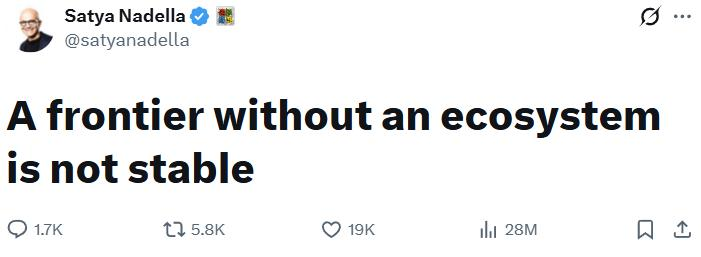
日前,微软 CEO 萨蒂亚·纳德拉(Satya Nadella)在X上发布了一篇长推文《A frontier without an ecosystem is not stable》,即「没有生态系统的前沿是不稳定的」。
该条推文一上线就吸引了大量关注,如今浏览量已经突破了 2800 万。
核心观点归纳一下,聊了四件事
一、未来企业的资产架构:
分为两种:
①人类资本:包含员工的知识、判断力、人脉关系、独创性以及核心的模式识别能力。
②Token资本(即AI能力):企业所构建、拥有并掌控的AI能力(计算、模型与自动化系统)。
二、未来企业竞争力的转变
①过去企业的竞争力来源于某个系统或工具
②未来企业的竞争力,建立自己的学习闭环,建立一个持续进化的登山机。
③企业可以外包任务甚至岗位,但绝不能外包学习能力。
三、未来企业的AI架构
①底层解耦通用模型:
企业必须有能力随时更换底层的通用型模型,而不丢失企业自身沉淀下来的、如同公司老员工般的专业经验。
②上层构建私有进化环境:
私有评估体系:不看外部刷榜排名,只考核模型对企业核心商业目标的实际贡献。
私有强化学习:让模型在企业内部的实际运行轨迹中吸取教训、自主成长。
专属知识库:让制度化记忆变得可检索,提升Token使用效率。
四、建立前沿生态:绝不能让少数AI巨头吸干所有行业的价值
①反对垄断与价值闭环:如果所有经济价值都被少数几个全知全能的超级大模型吞噬,导致所有行业的知识被彻底商品化(低价贬值),全社会和政治经济结构将无法容忍。
②历史的教训:第一阶段全球化通过外包掏空了实体工业经济,虽然账面GDP好看,但带来了深远的社会撕裂。AI时代绝不能重蹈覆辙,绝不能让少数AI巨头吸干所有行业的价值。
以下为中文翻译内容:
我一直在思考,公司在人工智能驱动的经济环境下的未来发展方向。
这次转型与以往任何平台变革都截然不同。过去,我们利用数字系统来提升人力资本。而现在,我们首次能够在人与数字系统之间建立真正的认知闭环。这令人耳目一新,因为它彻底改变了我们对企业内部工作的理解。
关键不在于某些数字工具或系统及其使用,而在于在人工智能模型可以不断吸收人类和组织的专业知识并将其商品化的世界中,组织如何继续学习、构建知识产权、实现差异化并蓬勃发展。
每家公司都必须构建我所谓的人力资本和Token资本。人力资本包括员工的知识、判断力、人脉关系、创造力和模式识别能力,而Token资本则是公司构建和拥有的人工智能能力。
重要的是,随着Token资本的增长,人力资本的价值并不会降低,只会增加!
我相信人的主动性将是Token资本增长的驱动力。人类会设定远大的目标,将不同领域的信息联系起来,建立人脉关系,并识别出最重要的模式。如果没有人的引导,计算机就会原地打转。
这意味着真正的机遇不在于选择最佳模型,而在于构建一个基于模型的学习循环,使人力资本和Token资本能够复利增长。你可以外包一项任务,甚至一份工作,但你永远无法外包学习。
企业的未来在于能否在人员和人工智能之间复利增长这种学习成果。
这需要一种全新的架构方法,让每个企业都能构建随着时间推移不断改进的智能系统,同时又能保持对其知识产权的控制权。企业应该能够在不丢失其学习系统中内置的“公司资深人士”专业知识的情况下,替换掉现有的“通用”模型。这将是未来时代对企业控制权和自主权的关键“考验”。
企业需要将自身的工作流程、领域知识和积累的判断转化为人工智能系统,并使其在每次使用中不断改进。私有评估应能捕捉模型是否真正针对对业务至关重要的结果(而不仅仅是外部基准!)进行了改进。私有强化学习环境应允许模型基于组织内部的真实数据不断成长。其知识库使机构记忆可查询,并提高了Token的使用效率。
这个循环将成为公司新的知识产权。
我把它比作一台爬山机器。与大多数资产不同,它具有复利效应。每一次工作流程的改进都会产生更好的训练信号,从而加速公司独有的隐性知识的积累。那些早期构建这一循环的公司将拥有难以复制的优势,无论其拥有何种新的单一模型能力。
我们最不希望看到的就是,所有行业、所有公司都将价值拱手让给少数几个攫取一切的模型。如果所有价值都集中在少数几个模型手中,政治经济体系绝对无法容忍。社会绝不会允许人工智能的未来掏空整个行业。
想想全球化第一阶段发生了什么,外包掏空了整个工业经济体。表面上看,GDP数据看起来不错,但产业转移是真实存在的,其后果至今仍在显现。我们绝不能让这种模式重演到人工智能时代,让少数人工智能系统攫取所有经济利益,而整个行业却眼睁睁地看着自己的知识被商品化,最终被彻底摧毁。
我认为,我们的首要任务必须是构建一个前沿生态系统,而不仅仅是一个前沿模式,这样价值才能广泛地流遍每家公司、每个行业和每个国家。在这个生态系统中,每个组织都能拥有编码其机构知识的学习循环,从而不断积累其人力资本和Token资本。
我从小就秉持着这样的理念:平台能够创造比平台本身所能提供的价值更大的额外价值,并且每家公司都可以不断创新,创造属于自己的价值。
当这种情况发生时,企业不仅能为自身创造价值,还能为周边经济创造价值。员工的专业知识将得到提升,他们的判断力将融入到可复制、可扩展的系统中,而企业和周边社区也将从中受益。
这就是企业如何为自身和更广泛的经济创造价值的方式。而这正是我们应该共同构建的稳定平衡。
相关链接
经典培训课程
企业AI知识库搭建与运营培训课程
呼叫中心AI知识库培训课程
个人知识体系构建能力课程
书籍和资料
《卓越密码如何成为专家》
《你的知识需要管理》
免费电子书《企业知识管理实施的正确姿势》
免费电子书《这样理解知识管理》
知识库知识管理系统
企业AI知识管理知识库软件系统清单
个人知识管理软件AI知识库系统清单
英文全文
I’ve been thinking about the future of enterprises in an AI – driven economy.
This transformation is different from any previous platform change. In the past, we used digital systems to enhance human capital. This is the first time we’ve been able to establish a true cognitive loop between humans and digital systems. This is very mind – boggling because it changes the way we conceive work within enterprises.
The key issue goes beyond the use of certain digital tools or systems. We need to focus on how organizations can continuously learn, build intellectual property, maintain differentiation, and thrive in a world where AI models can continuously absorb the professional knowledge of humans and organizations and commercialize it.
Every company must build what I call “Human Capital” and “Token Capital”:
“Human Capital” includes employees’ knowledge, judgment, interpersonal relationships, creativity, and pattern recognition ability.
“Token Capital” represents the AI capabilities that a company builds and owns.
Importantly, the value of human capital does not decrease as token capital grows. It only becomes more valuable! I believe that human initiative will be the driving force for the growth of token capital. Humans will set ambitious goals, connect information across domains, build relationships, and identify the most critical patterns. Without human guidance, computing resources will just spin in place.
This means that the real opportunity doesn’t lie in choosing the best model. “We should build a learning loop on top of the model, where human capital and token capital generate compound interest.” You can outsource a task or even a job, but you can never outsource your learning process. The future of enterprises depends on the ability to accumulate this learning compound interest between humans and AI.
This requires a new architectural solution that allows every company to build an agent system that evolves over time while still maintaining control over its intellectual property. A company should be able to replace the “general” model while still retaining the “veteran – level” professional knowledge accumulated in its learning system. This will be a key “test” of your control and sovereignty in the future.
“Enterprises need to transform their workflows, domain knowledge, and accumulated judgment into AI systems that can improve with each use.” Private evaluation systems should be able to capture whether the model is truly making progress on outcomes that are crucial to the enterprise (just looking at external benchmark tests is not enough!). Private reinforcement learning environments should make the model more powerful in the real execution trajectories within the organization. Its knowledge base makes institutional memory searchable and also makes the use of tokens more efficient.
“This loop will become the new intellectual property of the enterprise.” I see it as a mountain – climbing machine. And unlike most assets, it has a compound – interest effect. Every improved workflow will generate better training signals, which will accelerate the accumulation of the enterprise’s unique tacit knowledge. Companies that build this system early will have an advantage that is difficult to replicate, no matter what new capabilities individual models may have.
“We don’t want to see a world where every company in every industry is ceding value to a few all – consuming models.” Assuming that all the value is captured by a few models, the political – economic system will not tolerate such a situation. Society will not allow an AI future that empties an entire industry.
Recall what happened in the first stage of globalization when the entire industrial economy was hollowed out due to outsourcing. Although the GDP data looked good on the surface, the loss of jobs was real, and its consequences are still far – reaching. “We must not bring that dynamic into the AI era, allowing a few AI systems to capture all the economic returns while the entire industry watches their knowledge being commercialized unknowingly.”
In my view, “Our top priority must be to build a frontier ecosystem.” Just building a frontier model is far from enough. Only in this way can value flow widely among every company, every industry, and every country. In this ecosystem, every organization can have a learning loop that encodes its institutional knowledge and allows its human capital and token capital to generate compound interest.
This is the concept I followed during my growth: a platform should enable more value to be created on it than what it captures internally, allowing every company to continuously innovate and create its own value.
When this happens, enterprises will create value for themselves and the surrounding economy. Employees will see their professional knowledge amplified, and their judgment will become part of the system, becoming replicable and scalable. At the same time, the benefits will benefit the enterprises and communities around them.
This is how enterprises drive value for themselves and the broader economy. This is also the stable balance we should build together.
